
Employee Appreciation Day Cards That Feel Less Like a Mass Email
A four-week rollout for an Appreciation Day card send, including segmentation, manager input, approvals, and the cases HR should hold.
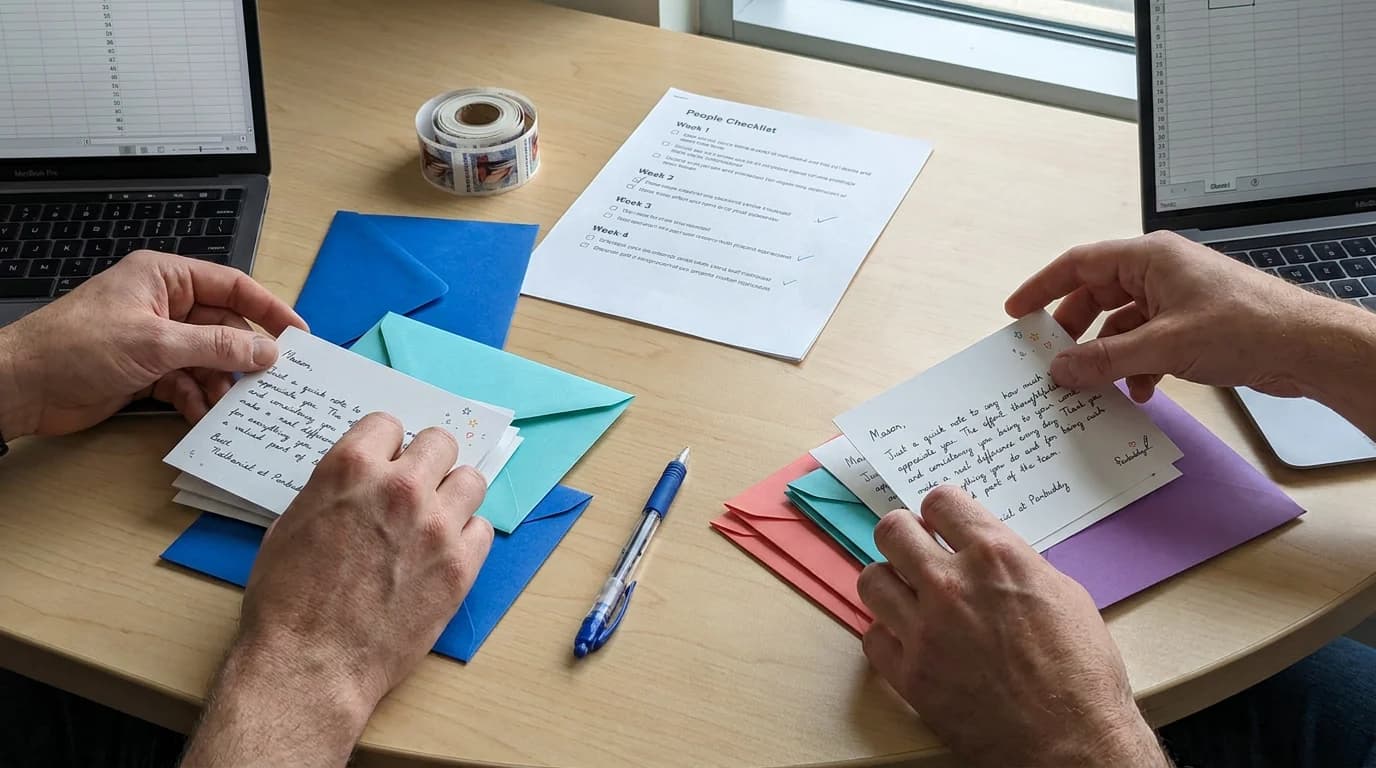
Decide what the day can honestly carry
Appreciation Day can give the company a shared reason to say thank you. It cannot make a once-a-year message feel personal when the rest of the employee experience says otherwise. Mental Health America's 2024 report found that 78% of employees understood how their work contributed to organizational success while 59% felt appreciated by their employer. Contribution and appreciation are not the same experience.
Source:Mental Health America, 2024 Mind the WorkplaceSet a modest goal: every eligible employee receives an accurate, considerate note through a channel they have agreed to use. Save retention promises, culture declarations, and performance messages for places where the company can support them with action.
Week four: settle the audience and the rules
- Name the executive sponsor, campaign owner, data owner, copy approver, and fulfillment owner.
- Define whether employees, contractors, interns, temporary staff, people on leave, and recent hires are included.
- Choose the recognition date and realistic arrival window for each country or region.
- Confirm the approved source for names and mailing addresses, plus the employee opt-out path.
- Set the budget using the eligible recipient count and a documented exception reserve.
- Write hold rules for departures, active employee-relations matters, and unverified addresses.
If a newly eligible group is added, recalculate cost and timing, then tell the approvers. Quiet last-minute additions are how names, messages, and addresses get crossed.
Week three: segment only where it improves the truth
Useful segments reflect different work or context. A field team, overnight support group, recent acquisition, or new-hire cohort may deserve a sentence grounded in its year. Department names pasted into identical copy add little.
- Use team or role when daily work is meaningfully different.
- Use location when the local year included an event headquarters may overlook.
- Use tenure only when the message acknowledges a real stage, such as the first months after joining.
- Use manager detail for a smaller group where a specific observation is feasible.
- Keep one shared message when segmentation would create arbitrary tiers of warmth.
Week two: write, review, and count every version
A company-wide note might name the kind of work the group carried, acknowledge a difficult period without claiming it was enjoyable, and thank the employee directly. Skip a paragraph of values. Avoid “family,” “rockstar,” “above and beyond,” and promises that the year ahead will be easier unless leadership has a concrete basis for saying so.
Track each segment's recipient count, artwork, message, approver, and status. Reconcile segment totals with the eligible roster before fulfillment. PenBuddy can keep recipients, field assignments, artwork, copy, and review state together.
Week one: freeze the data and handle exceptions
- Recheck employment status, preferred names, address completeness, country format, and opt-outs.
- Review people on leave or in sensitive employment situations with the appropriate HR owner.
- Lock artwork and copy after final approval, then record any change with an owner and reason.
- Confirm recipient and cost totals before checkout.
- Save the approved source file and fulfillment record according to the company's retention policy.
- Prepare a response for returned mail, a missed employee, or a message error.
Add late recipients through the controlled workflow, update the total, and confirm the message version. Side spreadsheets make it hard to know who received what.
Failure cases to catch before the cards move
- A laid-off or departing employee receives upbeat copy about the future.
- A remote or international group is excluded because its addresses were harder to prepare.
- Executive messages are personal while frontline messages are visibly generic.
- The card thanks employees for resilience after leadership ignored the cause of the strain.
- A manager inserts performance feedback or confidential details into an appreciation note.
- The campaign arrives after a broad email announced that everyone had already been recognized.
Route questionable records to someone who understands the context. A neutral card or no card may be appropriate. Avoiding harm matters more than the completion rate.
Do something after the day
Within a week, reconcile fulfilled, held, corrected, and returned cards. Ask a small, representative group whether the message felt accurate and whether physical mail was welcome.
Use what you learned to choose recognition moments for the rest of the year. Manager notes and milestone cards can carry details that one company-wide day cannot.
Know when to postpone or reduce the send
Pause or narrow the campaign during an active layoff, payroll failure, major safety incident, or unresolved employee crisis. A card can still be appropriate for some teams, but leadership should review the context. More recognition spending does not guarantee a better program; Achievers reported that 63% of HR leaders expected recognition spending to rise while 40% said their program drove business results. Use that vendor research as a warning against treating activity as impact.
Source:Achievers 2024 State of Recognition