
Manager Thank-You Notes While the Work Is Still Fresh
Give managers prompts, deadlines, and clear guardrails so a specific thank-you can move from good intention to delivered card.
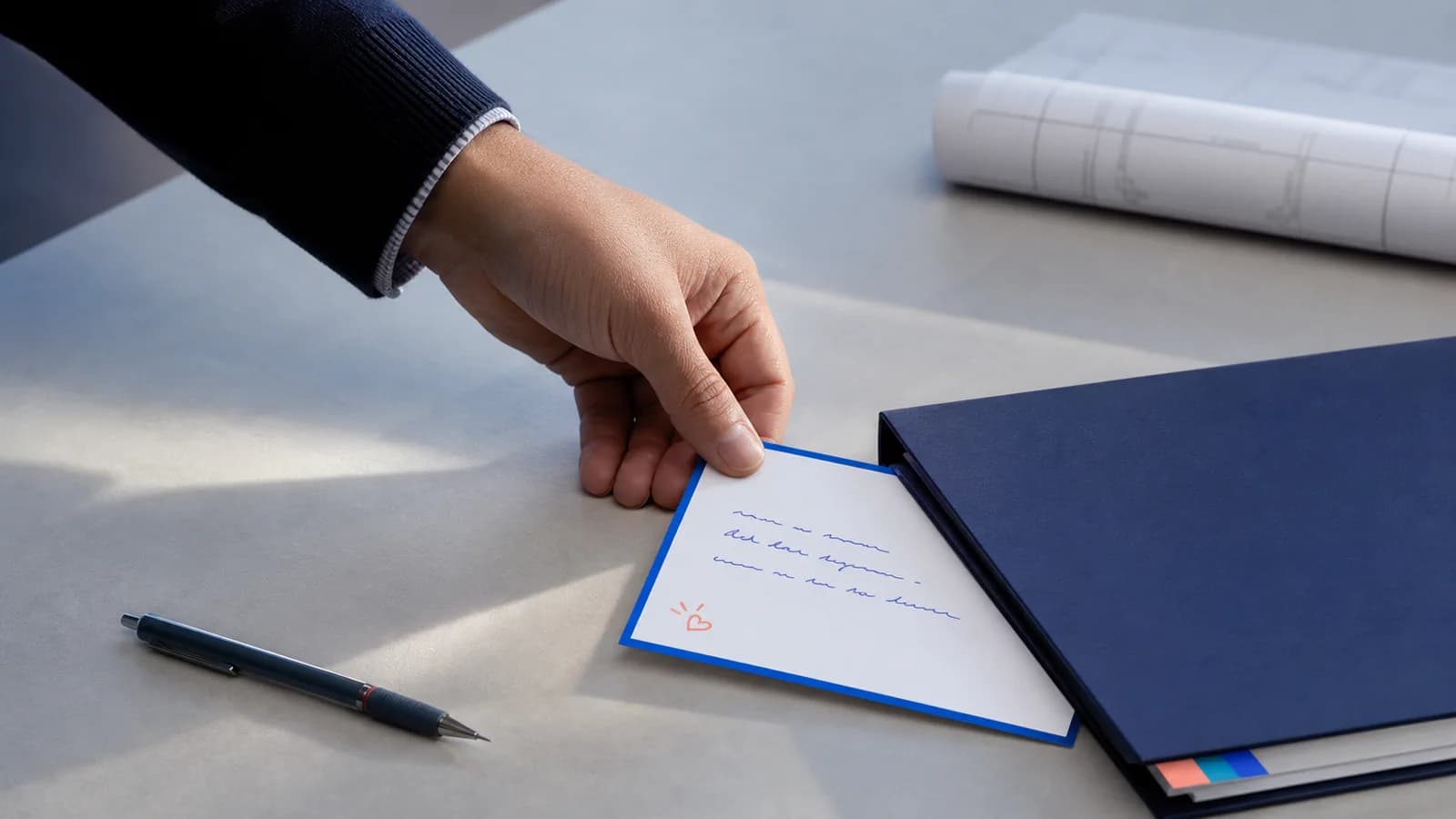
Managers hold the detail HR cannot see
The useful part of a thank-you note is often one sentence only the manager can write: what the employee noticed, prevented, carried, or made easier. Snappy's 2024 workforce study reported that direct managers were the most important source of recognition for 49% of working professionals. The same study found that managers often wanted help with gifting guidance. The takeaway is practical: keep the manager's perspective and remove unnecessary friction around the send.
Source:Snappy 2024 Workforce StudyCapterra reported that 53% of middle managers said they lacked enough time to fulfill their responsibilities. A program that requires a meeting, long nomination form, and three rounds of copy review will die quietly. Set a two-minute trigger, a clear approval path, and a deadline close to the work.
Source:Capterra middle manager researchStart with moments that deserve a private note
- An employee handled a difficult customer or operational issue with care.
- Someone did quiet work that prevented a larger problem.
- A teammate coached another person through a task outside their formal responsibility.
- A person raised a concern that improved safety, quality, or the customer experience.
- A sustained effort reached a meaningful point even if the final result was imperfect.
- An employee supported the team during change without being asked to absorb endless extra work.
Do not reserve cards for dramatic wins. Operations, support, coordination, documentation, and prevention are easy to overlook precisely because the work keeps trouble from becoming visible. HR can review patterns by team to find where only revenue or launch work receives attention.
Prompts that produce a real sentence
- What happened, in plain language?
- What did the employee choose to do that helped?
- Who felt the effect of that work?
- What specific detail would the employee recognize immediately?
- What should stay out because it involves a customer, health issue, investigation, or confidential result?
- Would the message still be fair if a teammate read it?
Keep the message to two or three sentences. Do not make managers imitate a corporate voice. HR should edit for safety, clarity, and basic respect while preserving the observation that made the note worth sending.
Set governance before the first request
Define who can request a card, who can receive one, what events qualify, the spending owner, the final approver, and the expected turnaround. Publish examples of prohibited content: protected-class references, medical or leave information, compensation, performance ratings, investigations, customer secrets, romantic language, inside jokes that can demean someone, and promises of promotion or reward.
- Route executive, legal, employee-relations, and sensitive-customer messages to an appropriate reviewer.
- Let employees opt out of home mail and provide another private channel.
- Keep home addresses hidden from the requesting manager whenever possible.
- Record the requester, recipient, reason category, approval, and fulfillment status.
- Create a correction path for the wrong recipient, wrong address, or message error.
Move quickly without turning recognition into a quota
Ask managers to submit a detail within two business days of the event. Review requests on a predictable cadence and show what is waiting, approved, held, or sent. PenBuddy can keep recipient data, card artwork, the message, and approval status together before fulfillment. Each approved message is written in ink with a real pen. Managers provide the reason; HR keeps the program accountable.
Avoid targets such as one card per manager per week. Quotas encourage vague praise and favor whatever happened near the reporting deadline. Watch for silence instead. If one team has no recognition for months, talk with the manager about visibility, workload, and whether the trigger is too difficult.
Failure cases need a response plan
- A manager repeatedly recognizes the same visible employee and misses quieter roles.
- Praise for working late rewards a schedule the company should be fixing.
- A note lands during a performance conversation and appears to contradict the manager's feedback.
- The card names confidential customer, health, or investigation details.
- HR rewrites every note into identical corporate language.
- Approval takes so long that nobody remembers what prompted the card.
Hold unsafe or confusing messages and tell the requester what needs to change. Do not silently replace the note with generic praise. When a pattern favors certain roles or people, coach the manager and examine who gets visible assignments. Recognition data can reveal a management gap; it should not be treated as a performance score by itself.
Review the program for fairness and usefulness
Track time from request to approval, held requests, address corrections, delivery exceptions, managers who participate, and recipient distribution across teams and work types. Sample messages for specificity. Ask recipients occasionally whether the note felt accurate and comfortable. People often underestimate how good a gratitude letter will feel to the recipient, according to experiments by Amit Kumar and Nicholas Epley, but the effect still depends on sincere wording and appropriate context.
Source:Kumar and Epley, Undervaluing Gratitude