
Handwritten Mail in an Employee Retention Program
Handwritten mail can make employee appreciation less disposable. It cannot repair poor management, pay, or workload. Here is the useful, limited role it can play.
Product details were checked on July 14, 2026. Features and prices change, so confirm purchase-critical requirements with the vendor. Product names belong to their respective owners; PenBuddy is not affiliated with the companies compared.
First, be clear about which relationship you are trying to keep
Customer retention mail belongs in a CRM and account strategy. Employee retention belongs in the working relationship: manager quality, pay, workload, growth, trust, respect, and whether people believe their contribution is noticed. A card touches only the last part directly.
That limited role can still be useful. Mental Health America's 2024 workplace report found that 78% of employees understood how their work contributed to organizational success, while 59% felt appreciated by their employer. Knowing your work matters and feeling personally appreciated are not the same experience.
Source:Mental Health America, 2024 Mind the WorkplaceA card is evidence of attention, not evidence that work is healthy
MIT Sloan Management Review and Revelio Labs analyzed more than 1.4 million Glassdoor reviews and found toxic culture was far more predictive of attrition than compensation in their model. A handwritten card cannot compensate for disrespect, retaliation, discrimination, impossible workload, or a manager who does not listen.
Source:Revelio Labs and MIT Sloan culture analysisUse mail after the company has something honest to say. If a team just finished a hard quarter, thank them and address the workload. If an employee raised a concern, respond to the concern before sending appreciation. Paper makes a message tangible; it does not make the underlying claim true.
Physical mail helps when digital recognition feels disposable
USPS reported in a 2020 survey that 65% of respondents said receiving cards and letters from friends and family lifted their spirits, and 62% felt more connected. That is personal-mail research during an unusual period, not an employee-retention study. It supports a modest point: receiving a physical message can feel emotionally different from receiving another digital notification.
Source:USPS: Cards and Letters Build ConnectionThe format works only when the note earns that attention. “Thanks for all you do” sent to everyone may be pleasant, but it offers no proof that anyone noticed the recipient. A useful note names a contribution, explains who it helped, or acknowledges an effort that could have stayed invisible.
Choose moments where the message has something real to say
- After onboarding: mention something the new hire has already contributed instead of repeating that the company is excited.
- At an early anniversary: name how the person's work or confidence changed during the year.
- After a difficult project: recognize the judgment, patience, or invisible coordination the result required.
- After customer praise: pass the specific feedback to the employee instead of keeping it in a leadership thread.
- During manager transitions: thank the people who held continuity while roles changed.
- After a promotion or expanded responsibility: recognize the work that led there, while making the new expectations clear elsewhere.
- Before a remote employee's milestone: confirm the home address and preference rather than treating private data as implied permission.
Do not reserve appreciation only for employees who stay late, rescue broken projects, or work visibly with executives. That teaches the company to recognize crisis and proximity. Look for reliable work, mentoring, maintenance, judgment, customer care, and improvements that prevent emergencies.
Build a cadence that does not turn into mail for mail's sake
Use roster dates for the moments the company has committed to recognize. Add manager-triggered notes for work a calendar cannot see. Then review distribution by team, location, job type, tenure, and manager. The review is not a quota; it is a way to spot patterns such as remote staff or operational teams receiving less attention.
- Monthly: check upcoming dates, missing addresses, and employees with recognition preferences.
- Before each batch: ask managers for one concrete detail and give them a real deadline.
- At approval: remove inflated claims, sensitive information, and copy that could go to anyone.
- After mailing: record status without promising an exact USPS arrival date.
- Quarterly: review who was recognized, why, and whether any team is consistently absent.
- Twice a year: ask employees whether the formats feel welcome, useful, or excessive.
Measure the program without claiming the card retained someone
Track operational measures first: eligible moments found, valid addresses, cards approved on time, send completion, manager participation, and gaps by team. Add a short employee question about whether recognition felt specific and welcome. Those measures tell HR what to improve in the program itself.
For retention, use broader evidence: exit interviews, stay interviews, manager changes, promotion access, workload, compensation, absence, engagement comments, and turnover patterns. Work Institute's 2025 report said preventable workplace issues accounted for 63% of exits in its data, but recognition is only one possible piece of that prevention work.
Source:Work Institute 2025 Retention ReportHow PenBuddy handles the mailing work
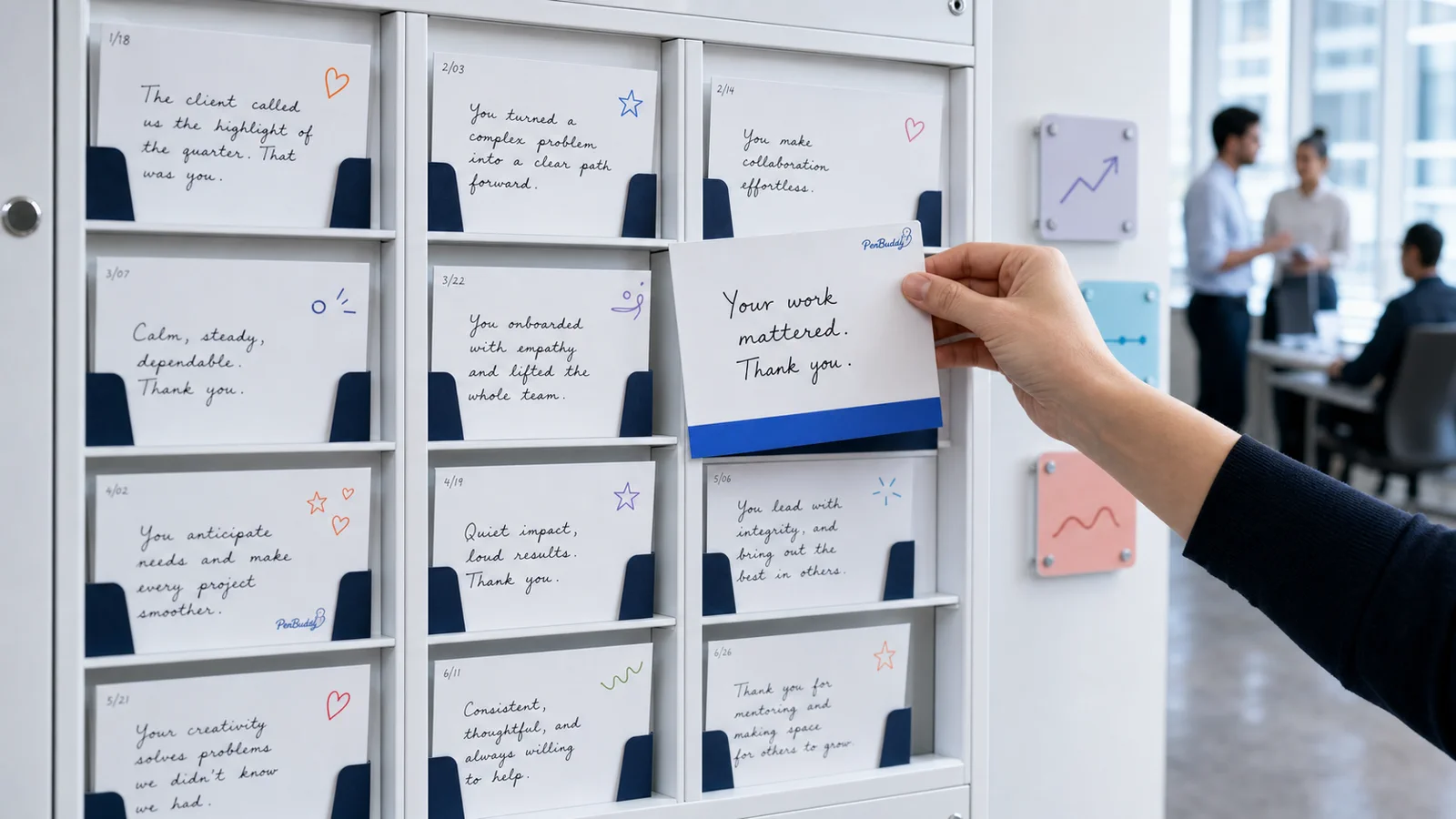
HR can import employee data and milestone dates by CSV, prepare scheduled or one-time sends, use approved message templates and merge fields, involve managers on applicable plans, review the batch, and see fulfillment status. The final 5-by-7-inch card is written with a real pen, addressed, stamped, and mailed.
PenBuddy does not guarantee lower turnover, fix engagement, or make a generic message personal. It removes much of the recurring card preparation and mailing work so HR can spend more attention on who should be recognized and what the note should actually say.